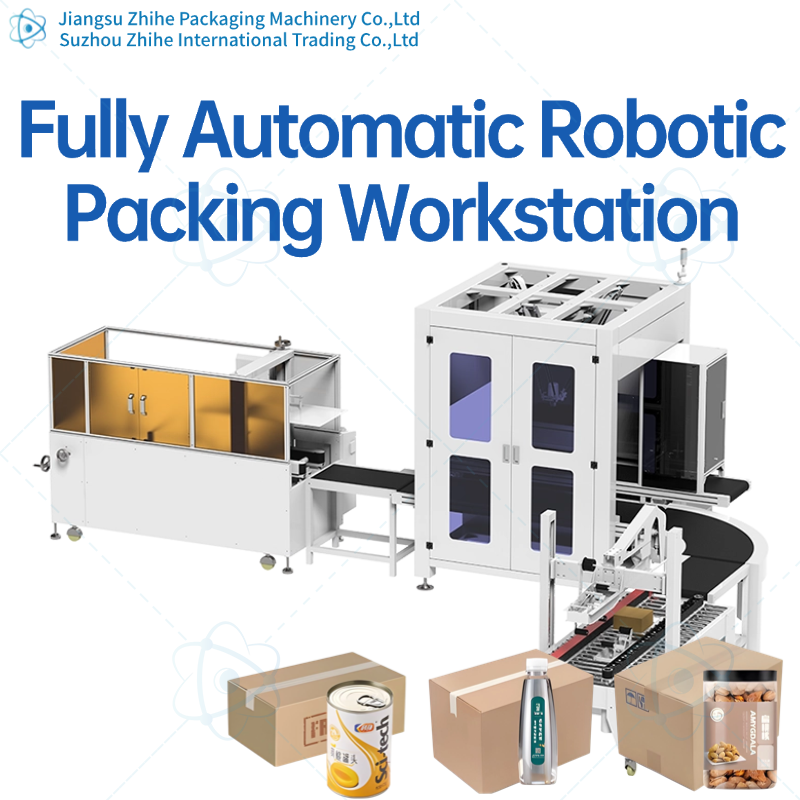

Essential details
MOQ:1
Lead time:45 working days
Shipping:Express Delivery, Air freight, Land freight, Ocean freight
Product Introduction


Q: What is the core working principle of this automated robotic workcell, and what are its primary advantages over traditional mechanical palletizers?
A: The workcell operates on a "Pick-and-Place" principle guided by integrated machine vision. A robotic arm, equipped with a custom End-of-Arm Tooling (EOAT), picks products (bags, boxes, bundles, etc.) from an incoming conveyor. It then places them in a pre-programmed, stable pattern on a pallet (or the reverse for depalletizing). Its key advantages include:
Extreme Flexibility: A single robot can handle multiple, vastly different products and pallet patterns by simply switching programs, unlike fixed mechanical systems.
Space Efficiency: The robot's large working envelope allows for complex palletizing in a compact footprint.
Gentle Handling: Servo-controlled motion and adaptive tooling minimize product damage, crucial for fragile items.
High Mix, Low Volume Ideal: Perfect for production lines with frequent SKU changes.
Q: What are the key hardware and software components of the workcell, and how are they integrated?
A: The system is a synergistic integration of several subsystems:
Robotic Manipulator: Typically a high-payload (e.g., 50-250kg) articulated 6-axis robot from brands like FANUC, ABB, or KUKA, chosen for reach, speed, and reliability.
End-of-Arm Tooling (EOAT): Custom-designed for the product. This can be a vacuum gripper (for boxes, bags), a mechanical clamp, or a hybrid system. It often includes a tool changer to handle different products.
Machine Vision System: A 2D/3D vision camera acts as the system's "eyes." It identifies the position, orientation, and sometimes the type of incoming product on the conveyor, providing offset data to the robot for precise picking. It also verifies pallet presence and layer completion.
Control & Software Suite: The robot's native controller is integrated with a supervisory PLC. The software includes:
Pallet Pattern Editor: An intuitive interface for creating and storing complex, layered pallet patterns.
Simulation Software: For offline programming and cycle time verification.
HMI (Human-Machine Interface): For operators to select recipes, monitor status, and view diagnostics.
Q: What types of products and packaging formats can this workcell handle? How does it manage product changeovers?
A: The workcell is highly adaptable. Common handled formats include:
Rigid Containers: Corrugated cases, totes, pails, trays.
Flexible Packaging: Bags (sealed or open-mouth), sacks, bundles.
Irregular Items: Tires, appliances, building materials (with specialized EOAT).
Product changeover is primarily a software-driven process. For a new product, the operator selects the corresponding program from the HMI. The system may automatically switch the EOAT or adjust vacuum/clampling pressure. The vision system is often trained to recognize multiple SKUs. This allows for changeovers in minutes, enabling true batch-size-of-one production.
Product changeover is primarily a software-driven process. For a new product, the operator selects the corresponding program from the HMI. The system may automatically switch the EOAT or adjust vacuum/clampling pressure. The vision system is often trained to recognize multiple SKUs. This allows for changeovers in minutes, enabling true batch-size-of-one production.
Q: What safety systems and maintenance considerations are in place?
A: Safety and maintenance are paramount in an industrial environment:
Safety: The workcell is enclosed by safety-rated fencing with interlocked access gates. Safety laser scanners or light curtains create protective zones—if breached, the robot slows down or stops. All systems comply with relevant international standards (e.g., ISO 10218, ISO/TS 15066 for collaborative applications).
Maintenance: Key considerations are:
EOAT Maintenance: Regular inspection of vacuum cups, filters, and seals or mechanical clamp components.
Robot Preventive Maintenance: Periodic lubrication, gearbox inspection, and battery backup checks as per the robot manufacturer's schedule.
Vision System: Keeping lenses clean and lighting consistent.
Diagnostics: The system provides predictive alerts for wear parts and detailed error logging to minimize downtime.
Q: What are the key performance metrics (like cycles per hour), and what factors influence the overall system output?
A: The key metric is layers or cases per hour. A typical high-speed workcell can handle 1,000-1,500+ cases per hour, but actual throughput depends on several factors:
Product Characteristics: Weight, size, and stability directly affect the robot's maximum safe speed.
Pallet Pattern Complexity: Dense, simple patterns are faster than intricate, interlocking ones.
Pick & Place Distance: The total travel path from the pick point to the furthest pallet corner.
Infeed Conveyor Stability: Consistent product spacing and orientation from upstream equipment are critical for maximizing the robot's efficiency without waiting or searching.
Peripheral Speed: The speed of the pallet conveyor and layer sheet dispensers must match the robot's cycle time to avoid bottlenecks.