
Essential details
MOQ:1
Lead time:30-40 working days
Shipping:Express Delivery, Air freight, Land freight, Ocean freight
Product Introduction


Q:
What is the core operational principle and purpose of a fully automatic box bag lifting and sealing machine?
What is the core operational principle and purpose of a fully automatic box bag lifting and sealing machine?
A:
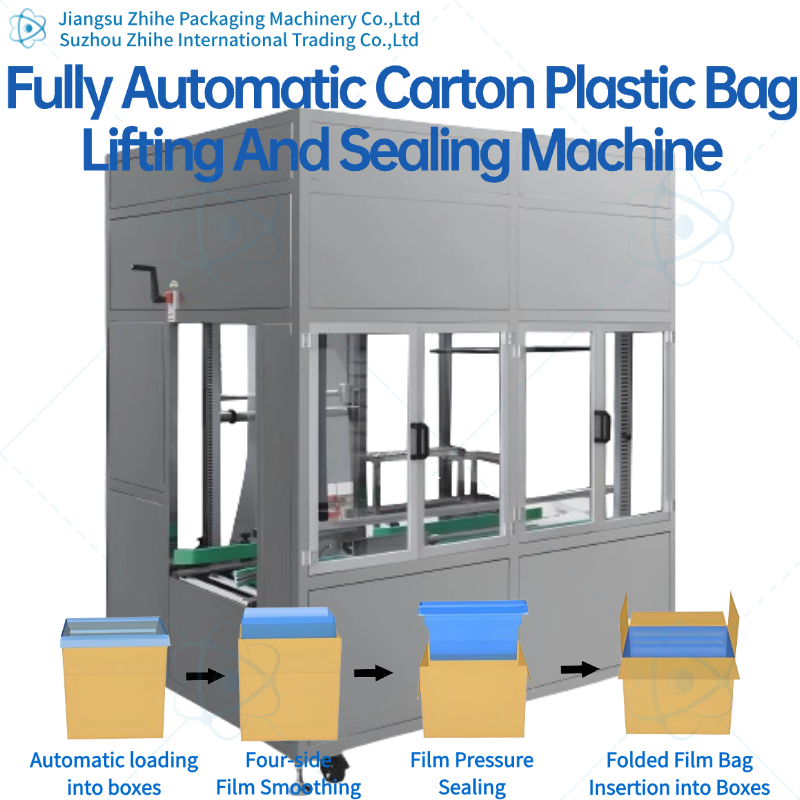
This machine automates the final step in automated box bagging lines. Its sole function is to grip, lift, and permanently seal a pre-positioned plastic bag that has been loosely placed over a corrugated box. The core principle involves a precisely timed, multi-axis mechanical process:
This machine automates the final step in automated box bagging lines. Its sole function is to grip, lift, and permanently seal a pre-positioned plastic bag that has been loosely placed over a corrugated box. The core principle involves a precisely timed, multi-axis mechanical process:
Sensing & Gripping: Sensors confirm a bagged box is in position. A servo-driven sealing head, equipped with custom grippers, descends to uniformly grasp the gathered neck of the plastic bag around the top of the box.
Tensioning & Lifting: The grippers lift the bag upward with controlled force, pulling it taut to eliminate all wrinkles and slack material from the box sides, ensuring a tight, professional appearance.
Sealing & Cutting: The gathered bag material is then fed into the sealing mechanism. The machine applies a clean, consistent closure (see Q2) and immediately trims away the excess material above the seal. The sealed box is then discharged.
This process is critical for achieving a secure, tamper-evident, and aesthetically pleasing finish that protects the box from dust, moisture, and contamination during storage and shipping.
Q:
What sealing methods are available, and how do I choose between heat sealing and twist-tying?
What sealing methods are available, and how do I choose between heat sealing and twist-tying?
A:
The choice depends on your product requirements, bag material, and desired package integrity.
The choice depends on your product requirements, bag material, and desired package integrity.
Heat Sealing (Impulse or Constant Heat):
Mechanism: Uses heated elements to melt and fuse the thermoplastic bag material (e.g., polyethylene) together, creating a permanent, hermetic weld.
Best For: Applications requiring a dust-proof and moisture-resistant seal, such as food, pharmaceuticals, electronics, or any product sensitive to the environment. It provides the highest level of security.
Twist-Tying / Wire-Tying:
Mechanism: Applies a pre-cut wire or plastic tie by twisting it tightly around the gathered bag neck.
Best For: Applications where easy reopening is needed by downstream users (e.g., logistics centers, distributors), or for products where a completely airtight seal is not critical. It is generally faster and works with a wider variety of film types.
Q:
How does the machine adapt to different box sizes and handle variations in bag presentation?
How does the machine adapt to different box sizes and handle variations in bag presentation?
A:
Modern machines achieve high flexibility through servo-driven automation and intelligent sensing.
Modern machines achieve high flexibility through servo-driven automation and intelligent sensing.
Size Adaptation: The sealing head's travel height, gripper spread, and sealing parameters are controlled by servo motors and stored as "recipes" in the Human-Machine Interface (HMI). Switching between pre-programmed box sizes is typically a one-touch operation, with auto-adjustment completed in seconds.
Handling Bag Variability: The system is designed to be forgiving. Tactile sensors or vision systems can detect the approximate position of the gathered bag neck. The grippers are often designed with self-centering or compliant mechanisms to ensure a secure grip even if the bag is not perfectly presented, preventing jams and maintaining high uptime.
Q:
What are the key performance specifications, and what factors most affect the machine's throughput?
What are the key performance specifications, and what factors most affect the machine's throughput?
A:
Key Specifications:
Key Specifications:
Cycle Time: Typically 4 to 10 seconds per box, with twist-tying often at the faster end of the range.
Box Size Range: Varies by model (e.g., L200-600mm x W150-450mm x H100-400mm).
Bag Material Thickness: Commonly handles 30-100 micron polyethylene films.
Factors Affecting Throughput: The limiting factor is rarely the sealer itself, but rather:
Upstream Process Consistency: The speed and reliability of the preceding box bagging machine that places the loose bag. Any misalignment or irregular bag presentation forces the sealer to pause or adjust.
Box/Bag Quality: Severely misshapen boxes or bags with inconsistent film properties can cause handling delays.
Q:
What are the critical maintenance routines and standard safety integrations?
What are the critical maintenance routines and standard safety integrations?
A:
Critical Maintenance:
Critical Maintenance:
Daily: Clean the gripper pads or suction cups; remove any melted plastic residue from heat sealing jaws (if applicable); clear film debris from the cutting blade area.
Weekly: Inspect the sealing element (heater band or tie head mechanism) for wear; check and adjust the tension of drive belts; lubricate linear guides.
Monthly: Verify the calibration of all sensors; test the safety interlock circuits; inspect electrical connections for integrity.
Standard Safety & Integration:
Safety: The machine is fully enclosed with safety-rated interlocked guards. Opening a guard triggers an immediate stop. It features emergency stop buttons and complies with international machinery safety directives (e.g., CE, UL).
Integration: It is designed as an inline module and communicates with the upstream bagging machine and conveyor system via PLC (e.g., Ethernet/IP, Profinet) or standard I/O signals for synchronized start/stop control. Common options include a reject gate to divert boxes with failed seals and an inkjet printer to date-code the sealed bag.