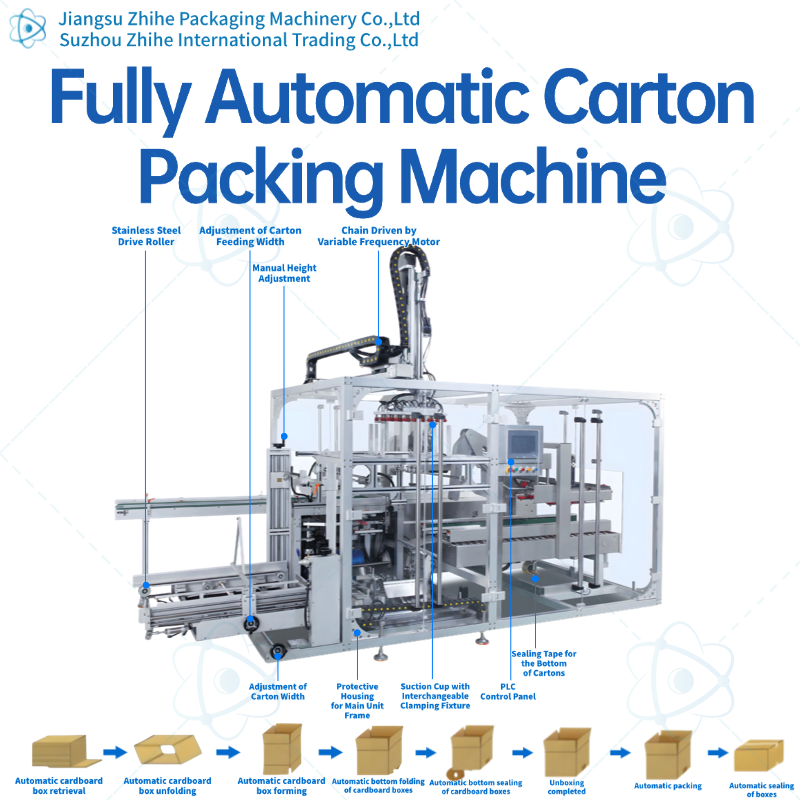

Essential details
MOQ:1
Lead time:30 working days
Shipping:Express Delivery, Air freight, Land freight, Ocean freight
Product Introduction


Q:
What is the core function and typical working principle of a fully automatic case packer?
What is the core function and typical working principle of a fully automatic case packer?
A:
A Fully Automatic Case Packer is designed to automate the process of loading primary product packages (e.g., bottles, cartons, pouches, cans) into a shipping case or tray. Its core function is to replace manual labor with a high-speed, precise, and repeatable robotic or mechanical system. The typical workflow is:
A Fully Automatic Case Packer is designed to automate the process of loading primary product packages (e.g., bottles, cartons, pouches, cans) into a shipping case or tray. Its core function is to replace manual labor with a high-speed, precise, and repeatable robotic or mechanical system. The typical workflow is:
Case Erection & Presentation: A flat corrugated case blank is fed, erected into an open sleeve, and bottom-sealed (often by an integrated or upstream case erector). It is then conveyed to the loading station.
Product Infeed & Pattern Formation: Products arrive in a single or multiple lanes from upstream equipment (e.g., filler, cartoner). The packer's infeed system, using guide rails, screw conveyors, or buckets, gathers and arranges them into the precise multi-layer pattern (e.g., 3x4, 4x6) required for the case.
Loading: The formed product group is then transferred into the open case. This is achieved through one of two primary methods:
Mechanical/Pusher Type: A sweeping plate or pusher head gently pushes the entire product group off a platform and into the waiting case.
Robotic Type: A robotic arm equipped with a custom end-effector (vacuum gripper, clamp) picks up the product group and places it into the case. Robots offer superior flexibility for complex patterns or fragile products.
Case Closing & Sealing: The filled case is transported to a closure section where the top flaps are folded and sealed with hot melt glue or tape.
Q:
What are the main differences between Robotic and Mechanical (Pusher) Case Packers, and how do I choose?
What are the main differences between Robotic and Mechanical (Pusher) Case Packers, and how do I choose?
A:
This is a fundamental choice based on production needs.
This is a fundamental choice based on production needs.
| Feature | Robotic Case Packer | Mechanical/Pusher Case Packer |
|---|---|---|
| Core Principle | Articulated robot arm picks and places product groups. | Linear actuator pushes product groups into case. |
| Flexibility | Extremely High. One robot can handle vastly different products and case patterns with quick program changes. Ideal for High-Mix, Low-Volume production. | Lower. Primarily designed for a specific range of similar products and fixed patterns. Best for High-Volume, Low-Mix lines. |
| Speed | Moderate to High (e.g., 10-20 cases/min). Speed is limited by the robot's cycle time and travel distance. | Very High (e.g., 20-40+ cases/min). Can be faster for simple, continuous patterns. |
| Footprint | Larger, requires the robot's working envelope. | Typically more compact for equivalent throughput. |
| Product Handling | Gentler. Suction gripping is ideal for fragile, decorated, or unstable primary packages. | Can involve sliding/tipping, which may not be suitable for very fragile or slippery products. |
| Best For | Frequent changeovers, multiple SKUs, complex patterns, fragile items. | Dedicated, high-speed lines with stable products and infrequent changeovers. |
Q:
What factors determine the maximum speed (cases per minute) of the machine?
What factors determine the maximum speed (cases per minute) of the machine?
A:
The theoretical maximum speed is determined by the machine's design, but the effective line speed is dictated by the system's slowest bottleneck:
The theoretical maximum speed is determined by the machine's design, but the effective line speed is dictated by the system's slowest bottleneck:
Product & Pattern Complexity: A simple pattern of 12 stable cans can be packed much faster than a complex pattern of 24 upright cartons that require precise orientation.
Infeed & Accumulation: The packer can only run as fast as the slowest upstream machine (filler, cartoner) can consistently supply products. A reliable accumulation system is crucial to buffer product flow.
Case Handling & Sealing: The speed of the integrated case erector and the hot melt glue setting time (for glue systems) can become the limiting factor.
Loading Method: As noted above, mechanical pushers generally have a higher pure speed ceiling for simple tasks than robots.
Q:
How are changeovers managed for different products or case sizes?
How are changeovers managed for different products or case sizes?
A:
Changeover ease varies significantly by machine type.
Changeover ease varies significantly by machine type.
Mechanical Packers: Changeover involves manual adjustments to guide rails, pusher heads, and pattern-forming platforms. This can take 30 minutes to several hours and requires skilled technicians. They are less suited for frequent changes.
Robotic Packers: Changeover is predominantly software-driven. The operator selects a new product recipe on the HMI. The robot automatically adjusts its tooling (if using a servo-driven gripper) and loads the correct motion program. Mechanical adjustments to the infeed lane dividers may still be required, but the core changeover can be achieved in under 10 minutes.
Q:
What are the key maintenance points and common optional integrations for a case packing line?
What are the key maintenance points and common optional integrations for a case packing line?
A:
Key Maintenance Points:
Key Maintenance Points:
Daily: Clean product contact surfaces, grippers, and sensors; check and clear any debris from the forming area.
Weekly: Lubricate chains, guide rails, and bearings; check pneumatic systems for leaks; inspect vacuum generators and filters on robotic grippers.
Monthly: Inspect wear parts like flight bars, pusher plates, and gripper pads; verify the alignment of all mechanical and sensing components; calibrate robotic axes if applicable.
Common Optional Integrations:
In-Line Case Erector & Bottom Sealer: Often integrated directly into the packer for a seamless flow.
Print & Apply Labeler: Applies an external label to the sealed case.
Vision Inspection Systems: Verifies correct product count, orientation, label presence, or date codes before the case is closed, allowing for automatic rejection of faulty packs.
Automatic Glue System (for top sealing): Provides a strong, tamper-evident seal.
Downstream Palletizer Interface: The case packer's PLC communicates directly with the palletizer to coordinate the flow of finished cases.