
Essential details
MOQ:1
Lead time:45 working days
Shipping:Express Delivery, Air freight, Land freight, Ocean freight
Product Introduction


Q:
What is the core function and working principle of this automatic drum bag lifting and sealing machine?
What is the core function and working principle of this automatic drum bag lifting and sealing machine?
A:
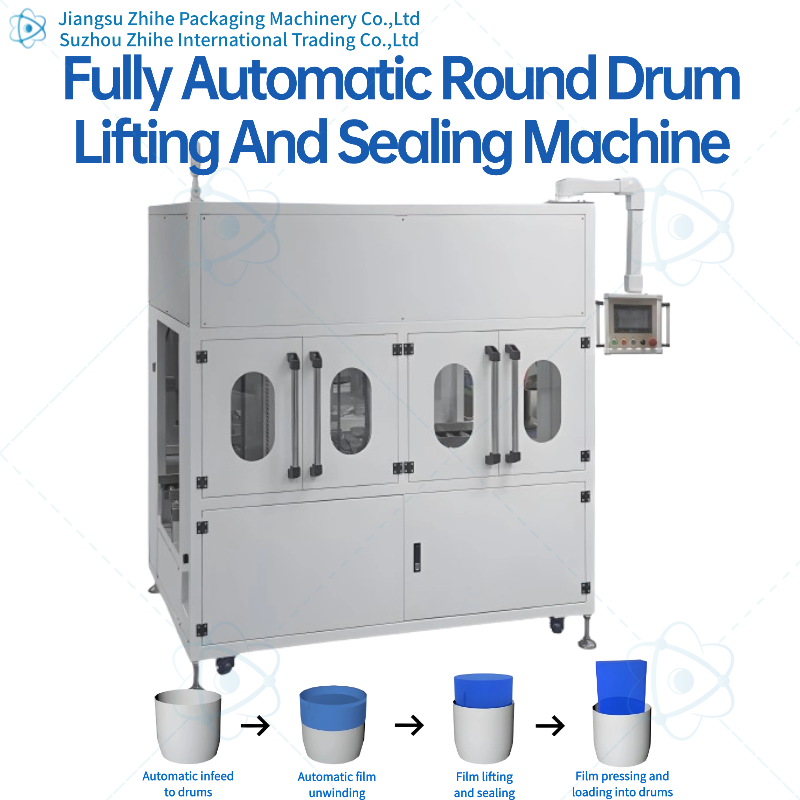
This machine is designed for the final stage of drum packaging: it automatically lifts and tightens a pre-positioned plastic bag (liner) over the mouth of an industrial drum (typically 20-220L) and applies a secure closure. The core working principle involves a three-step mechanized process:
This machine is designed for the final stage of drum packaging: it automatically lifts and tightens a pre-positioned plastic bag (liner) over the mouth of an industrial drum (typically 20-220L) and applies a secure closure. The core working principle involves a three-step mechanized process:
Bag Detection & Gripping: Sensors confirm bag presence. A lifting head with multiple, synchronized grippers (often vacuum or mechanical) descends to grasp the gathered bag neck uniformly around the drum's chime.
Lifting & Tensioning: The grippers lift the bag upwards with controlled force, pulling it taut over the drum's top and sides to eliminate wrinkles and slack. This tensioning is critical for a neat finish and effective sealing.
Sealing: The machine then applies the selected sealing method to the gathered neck.
Q:
What types of sealing methods are available, and how is the appropriate one selected for different products (e.g., paint vs. granular chemicals)?
What types of sealing methods are available, and how is the appropriate one selected for different products (e.g., paint vs. granular chemicals)?
A:
The choice of sealing method depends on product characteristics, bag material, and required seal integrity. The two primary methods are:
The choice of sealing method depends on product characteristics, bag material, and required seal integrity. The two primary methods are:
Heat Sealing (Impulse or Constant Heat): Creates a permanent, fused weld on thermoplastic bags (e.g., polyethylene). It is ideal for liquid products (paint, solvents, adhesives) as it provides the highest level of leak resistance and vapor containment.
Twist-Tying / Wire-Tying: Applies a pre-cut wire or plastic tie by twisting it around the gathered bag neck. This method is preferred for dry or granular products (powders, pellets) or for applications where the bag may need to be opened and re-closed downstream. It is faster and works with a wider range of film types.
Selection Guidance: The machine can be configured with either system. For hazardous liquids, heat sealing is strongly recommended. For non-hazardous solids, twist-tying offers speed and flexibility.
Selection Guidance: The machine can be configured with either system. For hazardous liquids, heat sealing is strongly recommended. For non-hazardous solids, twist-tying offers speed and flexibility.
Q:
How does the machine adapt to handle different drum sizes and irregular bag presentations?
How does the machine adapt to handle different drum sizes and irregular bag presentations?
A:
The machine achieves versatility through programmable automation and adaptive tooling:
The machine achieves versatility through programmable automation and adaptive tooling:
Size Adaptability: The lifting head's travel height and gripper spread are automatically adjusted via servo motors based on the selected drum recipe from the HMI. Changeover between standard drum diameters/heights typically takes under 5 minutes without tools.
Handling Irregularities: Advanced models feature vision systems or tactile sensors to detect the bag's gathered position. The grippers can make micro-adjustments to ensure an even grip even if the bag is loosely or unevenly placed on the drum. This "forgiving" handling is key to maintaining high uptime in real-world conditions.
Q:
What special configurations are required for safe operation in environments with flammable solvents or combustible dust?
What special configurations are required for safe operation in environments with flammable solvents or combustible dust?
A:
Operations in paint or chemical plants often necessitate hazardous area certifications:
Operations in paint or chemical plants often necessitate hazardous area certifications:
Explosion-Proof (Ex) Design: For Zone 1/21 areas, the entire machine (including motors, sensors, and control cabinet) can be built to ATEX/IECEx or NEC (Class I, Div 1) standards. This involves using explosion-proof enclosures, air-purged panels, or intrinsically safe (IS) circuitry to prevent ignition.
Anti-Static & Grounding: All grippers and contacting parts are constructed from dissipative materials and are electrically grounded to prevent static discharge, which is a critical ignition risk when handling plastic films and flammable vapors.
Fume Management: An integrated local exhaust ventilation (LEV) hood can be mounted above the sealing station to capture and remove solvent vapors released during the bag manipulation.
Q:
What are the key performance metrics, and what regular maintenance is crucial for reliable operation?
A:
Key Metrics:
Cycle Time: Typically 8-15 seconds per drum, depending on sealing method and bag condition.
Uptime / Reliability: Designed for >95% uptime in continuous production, largely dependent on consistent bag quality and preventive maintenance.
Reject Rate: A well-tuned machine with good bag presentation should achieve a seal failure rate of <0.5%.
Crucial Maintenance:
Daily: Inspection and cleaning of grippers and sealing jaws (heat or tie head) to remove any film residue or adhesive buildup.
Weekly: Verification of sealing parameters (temperature, pressure, tie torque) and inspection of cutting blades for sharpness.
Monthly: Checking all pneumatic components (filters, regulators, cylinders) and verifying the calibration of sensors and safety interlocks. Lubrication of guide rails and bearings as per manufacturer specifications.