
Essential details
MOQ:1
Lead time:45 working days
Shipping:Express Delivery
Product Introduction


Q:
What is the core function and typical application workflow of this automatic drum bagging machine?
A:
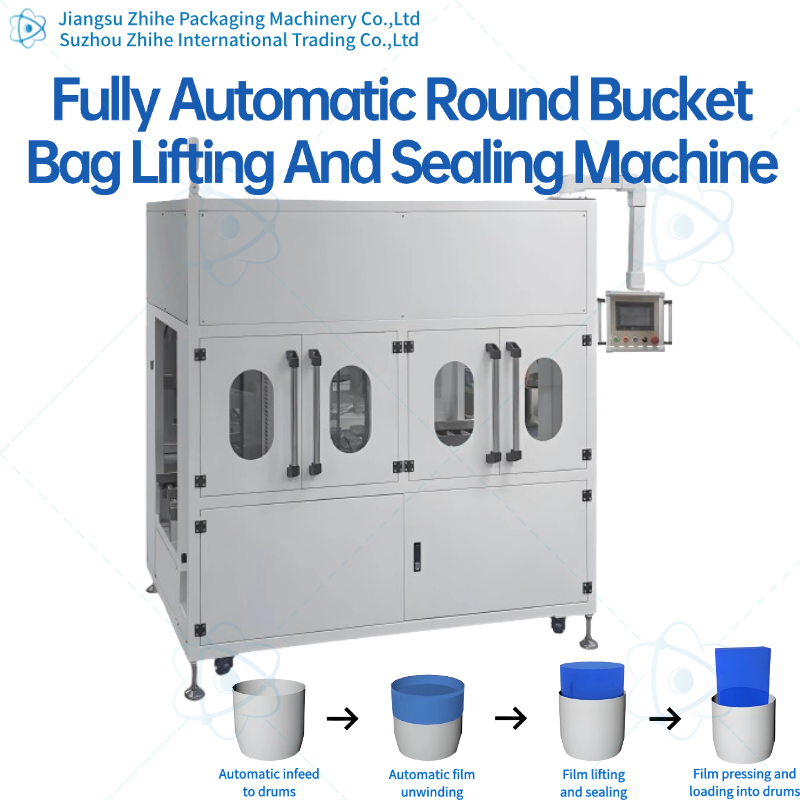
This machine is engineered to automatically apply a protective plastic bag (liner) over industrial drums, typically 20 to 220 liters (5 to 55 gallons). The core function is to provide a seamless, dust-proof, and contamination-free outer layer for drums containing paint, chemicals, adhesives, or food-grade products before palletizing and shipping. A standard workflow is:
An empty or filled drum is conveyed into the machine.
A pre-opened plastic bag is picked from a magazine and positioned over the drum mouth.
The machine uses a combination of mechanical fingers, grippers, and air inflation to fully expand the bag.
The expanded bag is then precisely lowered over the entire drum body.
The bag's open end is gathered, sealed (often with a twist-tie or heat seal), and trimmed. The fully bagged drum is then conveyed out for labeling or further handling.
Q:
How does the machine accommodate different drum sizes (diameter/height) and bag specifications?
A:
Flexibility is achieved through modular and programmable design:
Mechanical Adjustments: Key components like the bag magazine width, centering guides, and the lowering mechanism's height are adjustable, often via hand cranks with digital readouts or servo-driven auto-adjustment.
Tool-less Change Parts: For significantly different drum diameters (e.g., switching from a slim 30L to a wide 200L drum), the main drum centering cage or gripper arms may use quick-release pins for changeover.
HMI Recipe Control: All machine parameters—including gripper positions, inflation time, lowering speed, and sealing parameters—are stored in recipes on the Human-Machine Interface (HMI). Switching between drum/bag sizes involves selecting the corresponding recipe, with the machine automatically adjusting its settings. Changeover can typically be completed within 15-30 minutes.
Q:
What are the critical technical features for handling volatile or sensitive chemical environments?
A:
For chemical and paint applications, specialized configurations are paramount:
Explosion-Proof (EX) Certification: The entire electrical system, including motors, sensors, and control cabinet, can be built to ATEX Zone 2/22 or Class I Div 2 standards, using explosion-proof enclosures and components to prevent ignition in potentially flammable atmospheres.
Corrosion Resistance: All frames and components in the vapor zone are constructed from powder-coated carbon steel or stainless steel (AISI 304/316). Critical air systems may use coated or resistant materials to withstand corrosive fumes.
Fume Extraction: The workstation can be integrated with a local exhaust ventilation (LEV) hood to capture and remove volatile organic compounds (VOCs) or dust released during the bagging process, ensuring operator safety and environmental compliance.
Q:
What is the typical output speed, and what factors most significantly impact the overall cycle time?
A:
Standard machines have an output of 4 to 10 drums per minute. The cycle time is primarily influenced by:
Drum Consistency: Variations in drum height, chime (rolling hoop) geometry, or surface conditions (dents, wet paint) can cause sensing or handling delays.
Bag Material: The characteristics of the plastic film (LLDPE, LDPE, etc.)—its thickness, clinginess, and slip properties—directly affect how quickly and reliably it can be opened and separated from the stack.
Upstream/Downstream Integration: The machine's speed must be synchronized with the infeed conveyor (providing drums) and the outfeed system (removing bagged drums). Any bottleneck in these areas dictates the effective line speed.
Q:
What are the key maintenance points, and how does the system ensure operational safety?
A:
Maintenance Points:
Bag Separation System: Regular cleaning of suction cups and air knives to ensure reliable bag picking and opening.
Sealing Mechanism: Periodic inspection and cleaning of heat seal wires or tightening mechanisms for twist-tiers.
Pneumatic System: Routine draining of air filters and lubrication of pneumatic cylinders.
Sensors & Optics: Cleaning of photoelectric sensors and vision system lenses to maintain positioning accuracy.
Safety Systems:
Physical Guarding: The machine is fully enclosed with interlocked safety doors. Opening a door during operation triggers an immediate protective stop (Category 0 stop).
Advanced Safety: Optional safety laser scanners can create warning and stop zones around the machine perimeter.
Ergonomics: Designed to minimize manual lifting or handling, reducing operator strain and risk of injury.