
Essential details
MOQ:1
Lead time:30-45 working days
Shipping:Express Delivery, Air freight, Land freight, Ocean freight
Product Introduction


Q:
What is the standard workflow and principle of operation for a fully automatic cartoning machine?
What is the standard workflow and principle of operation for a fully automatic cartoning machine?
A:
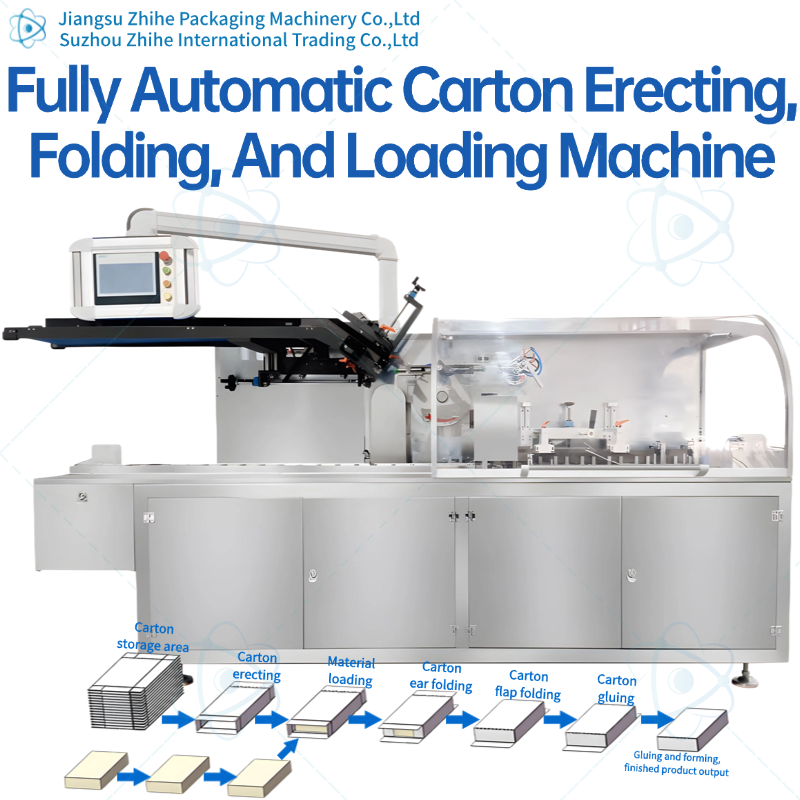
A fully automatic cartoning machine automates the process of inserting products, leaflets, and other components into pre-glued or tuck-style carton blanks. The standard workflow is a continuous, synchronized process:
A fully automatic cartoning machine automates the process of inserting products, leaflets, and other components into pre-glued or tuck-style carton blanks. The standard workflow is a continuous, synchronized process:
Carton Blank Feeding & Erection: Flat carton blanks are loaded into a magazine. A suction cup system picks a single blank, erects it into a rectangular sleeve, and transfers it to the main transport chain or flight bars.
Product Infeed & Insertion: Products (bottles, blisters, pouches, etc.) are conveyed in a single file from upstream equipment. The machine's infeed system (e.g., screw conveyor, bucket conveyor) precisely times and positions the product(s) before pushing or placing them into the open carton sleeve. Leaflets or instruction sheets are typically folded and inserted simultaneously by a separate unit.
Closing & Sealing: The filled carton moves to the closing station. For tuck-style cartons, mechanical fingers fold and tuck the minor and major flaps. For glue-style cartons, the flaps are folded, and hot melt adhesive is applied before pressing them shut. The closed carton is then discharged onto a conveyor.
Q:
What are the key differences between tuck-style and glue-style cartoning, and how do I choose?
What are the key differences between tuck-style and glue-style cartoning, and how do I choose?
A:
This is a fundamental choice based on packaging requirements and line speed.
This is a fundamental choice based on packaging requirements and line speed.
Tuck-Style Cartoning: The carton flaps are mechanically folded and interlocked. It is typically faster (suitable for high-speed lines > 200 cpm), requires no adhesive, and allows for easy, non-destructive reopening by the end-user. It is ideal for consumer goods (OTC pharmaceuticals, small electronics, food items).
Glue-Style Cartoning: The carton is permanently sealed with hot melt adhesive. It provides a more secure, tamper-evident seal, a cleaner, higher-end appearance with flat panels, and better stacking strength. It is commonly used for luxury items, heavier products, or where product protection is paramount (e.g., some cosmetics, software, hardware kits). The trade-off is slightly lower maximum speed and the need for a glue system.
Q:
How flexible is the machine for handling different carton and product sizes? What is the changeover process like?
How flexible is the machine for handling different carton and product sizes? What is the changeover process like?
A:
Flexibility is achieved through modular, adjustable components. Most machines are designed for a range of sizes.
Flexibility is achieved through modular, adjustable components. Most machines are designed for a range of sizes.
Adjustable Components: Key parts like the carton magazine, flight bars on the transport chain, product pushers, and folding ploughs are mechanically adjustable to accommodate different carton lengths, widths, and heights.
Changeover Process: Switching to a different carton/product size involves:
Adjusting the mechanical components mentioned above to new set points (often using tool-less hand cranks and digital scales).
Replacing any product-specific guides or tooling on the infeed.
Selecting the corresponding recipe on the Human-Machine Interface (HMI), which may automatically adjust servo positions and timing parameters.
A well-designed machine with a trained operator can complete a size changeover in 15-30 minutes.
A well-designed machine with a trained operator can complete a size changeover in 15-30 minutes.
Q:
What are the typical speed capabilities, and what factors most limit the maximum output?
What are the typical speed capabilities, and what factors most limit the maximum output?
A:
Speeds vary significantly by machine type and product complexity.
Speeds vary significantly by machine type and product complexity.
Standard Range: Intermittent motion machines typically run at 60-150 cartons per minute (CPM), while continuous motion machines can achieve 200-400+ CPM for simple, stable products.
Limiting Factors: The maximum speed is not determined by the carton erector alone, but by the slowest or least stable element in the process:
Product Characteristics: Fragile, unstable, or sticky products require gentler, slower handling.
Number of Components: Inserting multiple products and/or a folded leaflet per carton adds cycle time.
Carton Style & Quality: Complex carton structures (e.g., auto-lock bottoms, multiple internal partitions) or poorly scored/cut blanks slow down erection and closing.
Upstream Feeder Reliability: The cartoner can only run as fast as the slowest upstream feeder (e.g., blister packer, vial filler) can consistently supply product.
Q:
What are the critical maintenance points and common integration options for a cartoning line?
What are the critical maintenance points and common integration options for a cartoning line?
A:
Critical Maintenance:
Critical Maintenance:
Daily: Clean suction cups, product contact surfaces, and glue nozzles (if equipped). Clear any debris from the transport chain.
Weekly: Check and adjust belt tensions; lubricate chains and guide rails per the manual; inspect wear parts like flight bar grippers and folding tools.
Monthly: Inspect and calibrate critical sensors (photoelectric, proximity); verify the alignment of all mechanical stations.
Common Integration Options: A cartoner is the centerpiece of a secondary packaging line and can be integrated with:
Upstream: Blister packers, bottle cappers, pouch machines, vial fillers, and automatic leaflet feeders.
Peripheral: Vision Inspection Systems to check for correct product/leaflet presence, batch codes, or print quality before sealing. Print & Apply Labelers to apply labels to the sealed carton. Checkweighers to verify final package weight.
Downstream: Case packers, bundlers, or direct palletizing systems.