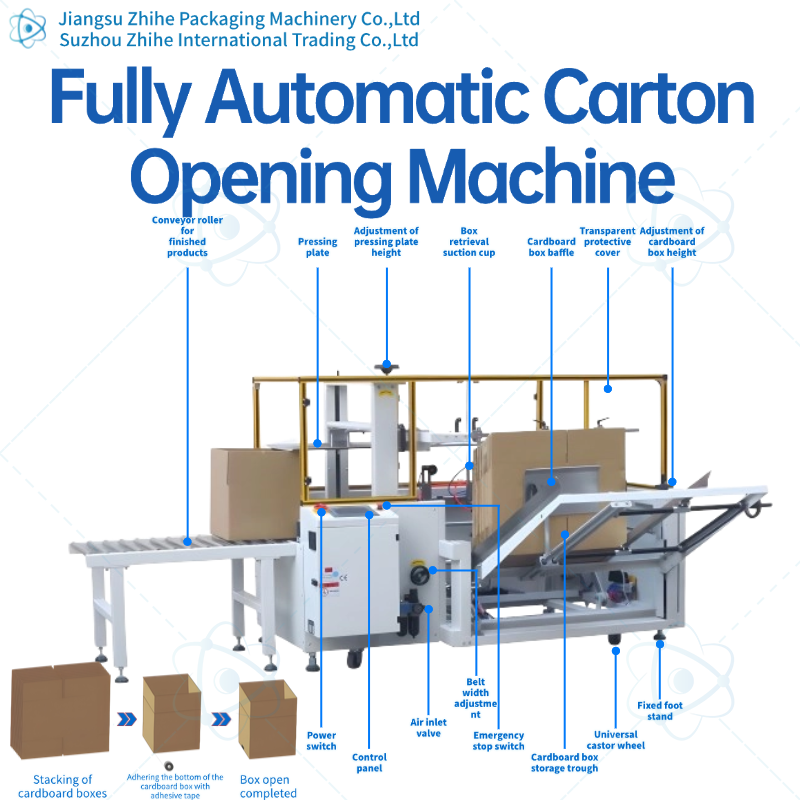

Essential details
MOQ:1
Lead time:30 working days
Shipping:Express Delivery, Air freight, Land freight, Ocean freight
Product Introduction


Q:
What is the core function and typical workflow of a fully automatic case erector?
What is the core function and typical workflow of a fully automatic case erector?
A:
A fully automatic case erector (or box forming machine) is designed to automate the first step in a packaging line: transforming flat, stored corrugated case blanks into open, squared, and bottom-sealed boxes ready for product loading. Its standard workflow is a precise, cyclic process:
A fully automatic case erector (or box forming machine) is designed to automate the first step in a packaging line: transforming flat, stored corrugated case blanks into open, squared, and bottom-sealed boxes ready for product loading. Its standard workflow is a precise, cyclic process:
Case Blank Feeding & Picking: Flat case blanks (RSC-style) are loaded into a vertical or horizontal magazine. A vacuum suction cup system (or mechanical grippers) picks a single blank from the stack using a combination of suction and friction.
Blank Positioning & Opening: The retrieved blank is pulled and positioned into the machine's forming area. Mechanical fingers, guide rails, and often a burst of compressed air are used to "break" the pre-glued joints and open the blank into a rectangular sleeve.
Bottom Flap Folding & Sealing: The open case sleeve is transported to the sealing station. Here, mechanical tuckers or folding arms first fold the minor flaps and then the major flaps in the correct sequence. The bottom is then sealed, either by:
Hot Melt Gluing: The most common method. Glue guns apply precise beads of hot melt adhesive to the flaps before they are pressed together, creating a strong, instant bond.
Pressure-Sensitive Tape: Taping heads apply tape over the center seam (and sometimes end seams) of the folded flaps.
Squared Case Discharge: The formed, bottom-sealed case is then pushed or conveyed out of the machine in a perfectly squared orientation, ready to be transferred to a case packer, bag inserter, or manual packing station.
Q:
What types of cases can this machine handle, and what are the key limitations regarding case specifications?
What types of cases can this machine handle, and what are the key limitations regarding case specifications?
A:
These machines are highly capable but are engineered for specific, standardized case styles.
These machines are highly capable but are engineered for specific, standardized case styles.
Primary Case Type: Regular Slotted Containers (RSC) are the standard and most reliably handled design. The machine can also typically run Full Overlap Containers (FOL) and Half Slotted Containers (HSC) with minor adjustments.
Key Case Specifications & Limits:
Size Range: Each machine model has a minimum and maximum case length (L), width (W), and depth (D). Exceeding these limits will cause jams or failed forming.
Board Quality: The corrugated board must have consistent caliper (thickness), proper scoring, and adequate bending strength. Warped, damp, or extremely low-quality blanks will cause misfeeds and poor forming.
Bottom Seal Type: The machine must be specified for either hot melt glue or tape sealing. Glue sealing is generally faster and stronger for automated lines.
Print & Coatings: Heavily varnished or UV-coated cases can be challenging for vacuum suction cups to grip reliably and may require special cup materials.
Q:
What is the typical operating speed (cases per minute), and what factors most significantly impact the machine's throughput?
What is the typical operating speed (cases per minute), and what factors most significantly impact the machine's throughput?
A:
Operating speeds vary by machine design and case size.
Operating speeds vary by machine design and case size.
Typical Speed Range: Standard intermittent-motion erectors operate at 10 to 25 cases per minute (CPM). High-speed, continuous-motion systems can achieve 30+ CPM.
Factors Impacting Throughput:
Case Size: Smaller cases can be processed faster than very large ones due to shorter stroke distances.
Case Complexity & Quality: Simple RSC cases with good board quality allow for maximum speed. Cases with special features (e.g., hand holes, tear tapes) or poor-quality blanks force the machine to slow down to ensure reliability.
Sealing Method: Hot melt gluing is generally faster than tape application for equivalent seal patterns.
Upstream/Downstream Synchronization: The erector's ultimate line speed is capped by the cycle time of the downstream case packer it is feeding. It must be synchronized to avoid bottlenecks or accumulation.
Q:
How is a size changeover performed, and what regular maintenance is crucial for reliability?
How is a size changeover performed, and what regular maintenance is crucial for reliability?
A:
Quick changeover and preventive maintenance are key to operational efficiency.
Quick changeover and preventive maintenance are key to operational efficiency.
Changeover Process: Switching to a different case size involves adjusting several key components to new set points, often guided by a "recipe" on the HMI:
Adjust the case magazine width to match the new blank size.
Adjust the forming mandrel or carriage width and depth.
Reposition the suction cup pick-up head travel.
Adjust the flap folding arms and glue gun/tape head positions.
On modern servo-driven machines, many of these adjustments can be automated via recipe recall. A manual changeover can take 5-15 minutes for a trained operator.
On modern servo-driven machines, many of these adjustments can be automated via recipe recall. A manual changeover can take 5-15 minutes for a trained operator.
Crucial Maintenance:
Daily: Clean vacuum filters and suction cups; clear corrugated dust from guides and sensors; check and clean glue nozzles (if equipped).
Weekly: Inspect and adjust chain/belt tensions; lubricate guide rails and bearings; check pneumatic filters and lubricators.
Monthly: Inspect wear parts like folding fingers, tuckers, and seal roller coverings; verify the calibration of all sensors and servo positions; inspect the glue system hoses and pumps.
Q:
What are the common integration options and safety features of an automatic case erector?
What are the common integration options and safety features of an automatic case erector?
A:
This machine is a core module designed for seamless line integration.
This machine is a core module designed for seamless line integration.
Common Integration Options:
Upstream: Typically integrated with an automatic case blank dispenser or de-palletizer for continuous feeding.
Downstream: Its primary link is to an automatic case packer (cartoner, tray packer, etc.). The formed case is usually transferred via a conveyor or direct flight bar system. It can also feed a semi-automatic station with a case accumulator.
Peripheral Systems: Often includes a print-and-apply labeler or inkjet printer to mark the case with batch/date info after forming but before packing. A case inspection system (e.g., to verify bottom seal integrity) can also be added.
Standard Safety Features: The machine is fully enclosed with hinged or sliding safety guards featuring electrical interlocks. Opening a guard during operation triggers an immediate machine stop. Emergency stop buttons are located at key points. All moving parts are guarded, and the control system includes overload protection for drives and mechanisms.