
Essential details
Quantity(pieces):1
MOQ:1
Lead time:30 working days
Shipping:Express Delivery, Air freight, Land freight, Ocean freight
Product Introduction


Q:
What is the core working principle of this powder packaging machine, and how is it specifically optimized for powdery materials compared to granular ones?
A:
A:
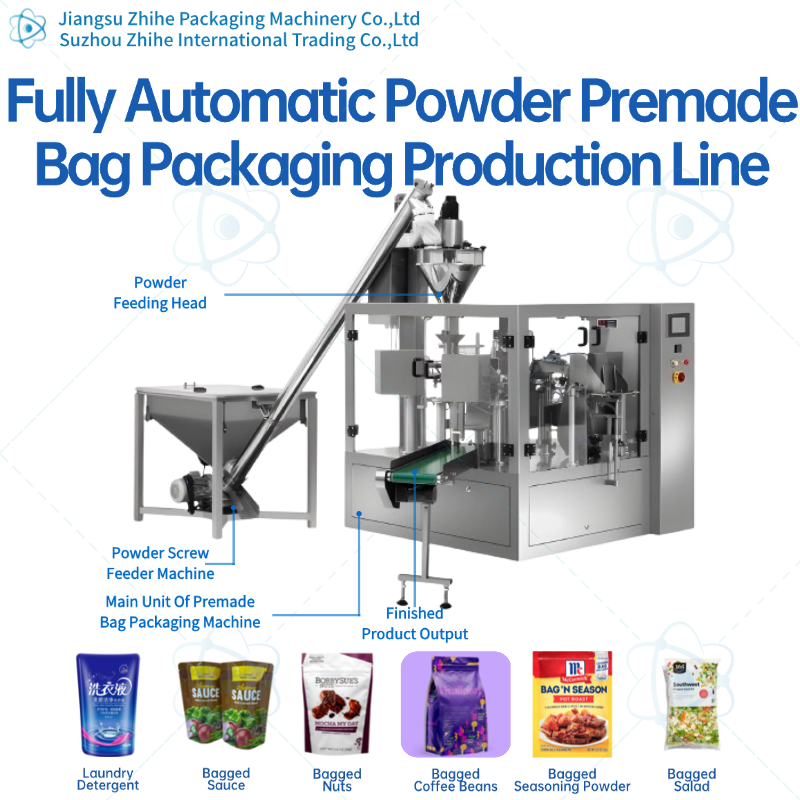
This machine operates on a pre-made bag pickup, opening, filling, and sealing cycle. Its core optimization for powders lies in a completely sealed filling system. Unlike open funnels for granules, it employs a "fill tube insertion" mechanism. The machine inserts a sealed fill tube deep into the pre-opened bag before dispensing. This, combined with integrated dust extraction ports at the bag mouth, creates a closed-loop path that contains dust within the system. Furthermore, all critical points are equipped with ionized air blowers to neutralize static charge on bags and equipment, preventing powder adhesion and ensuring clean sealing surfaces.
Q:
What types of powders can this machine handle, and what are the key material characteristics to consider?
A:
A:
The machine is engineered for a wide range of dry, fine powders, but performance is influenced by powder properties:
Excellent For: Free-flowing powders (e.g., milk powder, protein powder, flour, spices, additive powders), crystalline powders, and some cohesive powders.
Requiring Special Attention: Extremely low-density (aerated), highly hygroscopic (moisture-sensitive), or highly electrostatic powders. For these, we can specify options like de-aeration systems, climate-controlled filling hoods (low humidity), or enhanced ionization.
Key Characteristics: Bulk density, angle of repose, particle size distribution, and fat/oil content are critical for calibrating the filling system and choosing the right feed mechanism (e.g., single auger, twin auger, or vibratory tray).
Q:
How does the machine achieve precise dosing and high-speed operation with powders, which are prone to bridging and inconsistent flow?
A:
A:
Precision and speed are addressed by a dedicated powder dosing system coupled with smart controls.
Dosing System: Typically uses a servo-driven auger filler. The auger design (pitch, diameter) is matched to the powder's bulk density. For higher accuracy, a twin-auger system (main coarse feed + micro fine feed) is used. The machine precisely controls the number of auger rotations to dispense the set volume/weight.
Speed & Flow Assurance: To prevent bridging, the machine features vibrating or agitated hoppers above the auger. The fill tube design minimizes drop height and powder "dusting." Speeds of 20-50 bags per minute are typical, depending on bag size and powder weight. Weight feedback systems (check weighers) can be integrated to auto-correct the auger fill time for drift.
Q:
What are the critical hygiene, cleaning, and anti-contamination features of this machine?
A:
A:
Hygiene is paramount for powder packaging, especially in food and pharmaceutical applications.
Construction: All product contact parts are made of food-grade 304 or 316L stainless steel, with polished, crevice-free surfaces.
Quick Release & Cleaning: The entire product path—including hopper, auger assembly, and fill tube—features quick-release clamps for disassembly without tools in minutes, enabling fast cleaning and product changeover.
Sealed Design: The enclosed filling system prevents ambient contamination from entering the product. Options include CIP (Cleaning-in-Place) capabilities for the product zone and IP54/IP65 protection rating for electrical components to withstand washdowns.
Q:
How flexible is the machine for different bag styles and sizes, and what is the typical changeover process?
A:
A:
The machine offers significant flexibility within its designed range.
Bag Styles: It can handle various pre-made flat or stand-up pouches, including those with zippers, spouts, and degassing valves. The bag grippers and opening heads are adjustable or changeable.
Changeover Process: Changing bag size (within range) involves mechanical adjustments to the bag magazine width, gripper arm width, and fill tube height. These adjustments are often guided by scales on the machine. The key change parts (like auger size for vastly different fill weights) may need swapping. With standardized bags, a complete changeover can be achieved in 30-60 minutes. All machine parameters (auger speed, fill time, seal time) are stored in recipe memory on the HMI (Human-Machine Interface) for instant recall.