
Essential details
MOQ:1
Lead time:30 working days
Shipping:Express Delivery, Air freight, Land freight, Ocean freight
Product Introduction


Q:
What is the core operational principle and typical process flow of a fully automatic top and bottom case sealer?
What is the core operational principle and typical process flow of a fully automatic top and bottom case sealer?
A:
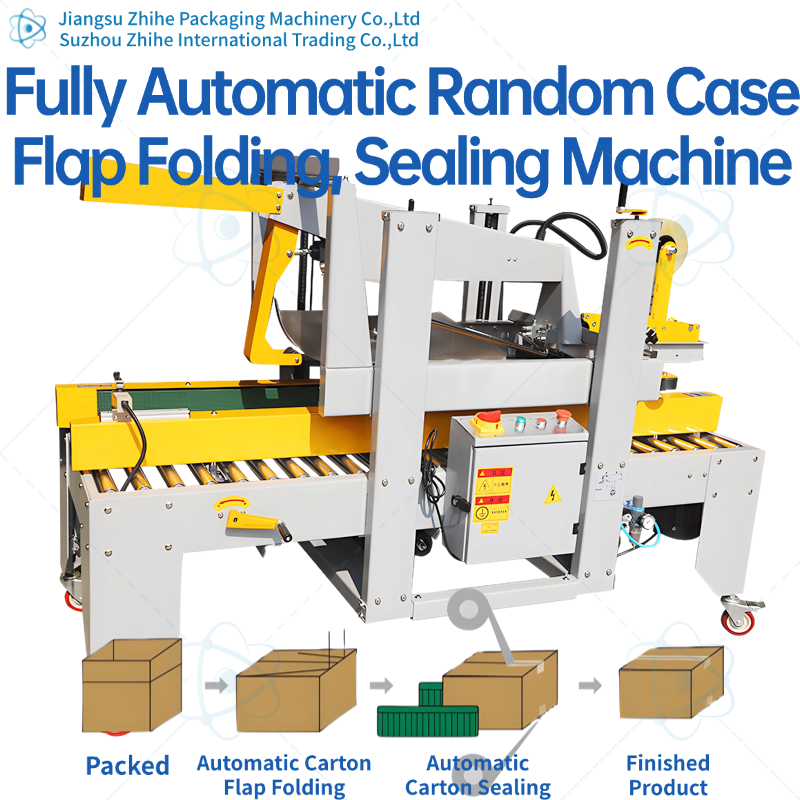
This machine automates the final step of case sealing after manual or automatic product loading. Its core principle is a continuous, synchronized mechanical process. The standard flow is:
This machine automates the final step of case sealing after manual or automatic product loading. Its core principle is a continuous, synchronized mechanical process. The standard flow is:
Case Infeed: An opened, loaded RSC (Regular Slotted Container) case enters the machine via an in-feed conveyor, typically guided by side belts for alignment.
Automatic Flap Folding: The case passes through a precisely calibrated "flap folding section." Here, a series of mechanical guides (often leaf-style or brush-type) first fold the minor (inner) flaps and then the major (outer) flaps on both the top and bottom of the case in the correct sequence. No manual intervention is required.
Tape Application & Sealing: Immediately after flap folding, the case moves into the "tape head section." Two independent taping units (one for the top, one for the bottom) apply pressure-sensitive adhesive tape over the center seam and sometimes the end seams (forming an "H" or "I" pattern). The tape is cut and wiped down to ensure adhesion.
Discharge: The fully sealed, tape-inspected case is discharged onto an outfeed conveyor, ready for palletizing or shipping.
Q:
What types and sizes of corrugated cases can this machine reliably handle?
What types and sizes of corrugated cases can this machine reliably handle?
A:
It is designed for standard RSC-style corrugated cases within a defined adjustable range, typically:
It is designed for standard RSC-style corrugated cases within a defined adjustable range, typically:
Dimensions: Minimum and maximum case dimensions are specified by the machine model (e.g., L: 150-600mm, W: 150-500mm, H: 100-450mm).
Flap Compatibility: It handles standard-length flaps. Cases with excessively long, short, or die-cut special flaps may require custom guides.
Material Quality: Cases must be within reasonable specification for warpage. Severely damaged or under-specified (low bursting strength) cases may cause jams.
Adjustability: Key components like the side-belt width, flap folder height, and tape head position are adjustable to accommodate the defined size range.
Q:
What is the realistic throughput (cases per minute), and what factors most impact line speed?
What is the realistic throughput (cases per minute), and what factors most impact line speed?
A:
Throughput typically ranges from 10 to 30 cases per minute (CPM) for standard models. The actual speed is determined by the bottleneck in the following sequence:
Throughput typically ranges from 10 to 30 cases per minute (CPM) for standard models. The actual speed is determined by the bottleneck in the following sequence:
Case Consistency & Infeed: The primary factor. Perfectly uniform, squared cases allow for maximum speed. Variations in case dimensions or warpage force the machine to run slower to ensure reliable flap folding.
Sealing Pattern Complexity: Applying a simple "I" pattern (center seam only) is faster than a full "H" pattern (center + end seams).
Upstream Process Integration: The sealer's speed must be synchronized with the preceding packing station's cycle time. Its maximum speed is only realized with a consistent, uninterrupted case supply.
Q:
How are changeovers for different case sizes performed, and what regular maintenance is critical?
How are changeovers for different case sizes performed, and what regular maintenance is critical?
A:
Changeover Process: Modern machines prioritize quick changeover.
Changeover Process: Modern machines prioritize quick changeover.
Mechanical Adjustment: Operators adjust side guide positions, flap folding mechanism height, and tape head placement using hand cranks or levers, often with digital readouts for precision.
Recipe Memory (Optional): Advanced models feature servo-driven adjustments controlled from an HMI. All positions for different case sizes are saved as "recipes" and can be recalled, automating the changeover in under a minute.
A full manual changeover between sizes within the machine's range can typically be completed in 2-5 minutes by a trained operator.
Critical Maintenance: To ensure reliability and seal quality:
Daily: Clean tape residue from rollers, blades, and sensors; visually inspect for worn guides or belts.
Weekly: Check and adjust drive belt tension; lubricate chains and guide rails as specified.
Monthly: Inspect and replace worn cutting blades, rubber friction belts, and compression rollers; verify all mechanical and sensor alignments.
Q:
What safety features, certifications, and integration options are standard?
A:
Safety & Compliance: The machine is fully guarded with interlocked safety doors/panels. Opening a guard triggers an immediate Category 1 or Category 0 stop (per ISO 13849-1). Electrical systems comply with relevant standards (e.g., CE, UL). Emergency stop buttons are located at key points.
What safety features, certifications, and integration options are standard?
A:
Safety & Compliance: The machine is fully guarded with interlocked safety doors/panels. Opening a guard triggers an immediate Category 1 or Category 0 stop (per ISO 13849-1). Electrical systems comply with relevant standards (e.g., CE, UL). Emergency stop buttons are located at key points.
Integration & Options: It is designed as a line module.
Standard Interface: Easily connects to upstream (packing stations, automatic case erectors) and downstream (conveyors, palletizers) via PLC communication (e.g., Ethernet/IP, Profinet) or simple sensor signals.
Common Options: These include print-and-apply labeling systems integrated before sealing, inkjet printers for date/code marking on the case, and tape seam detectors to verify seal integrity automatically.