
Essential details
MOQ:1
Lead time:30-45 working days
Shipping:Express Delivery
Product Introduction


Q:
What is the standard workflow and core function of this automatic flap folding, sealing, and taping machine?
A:
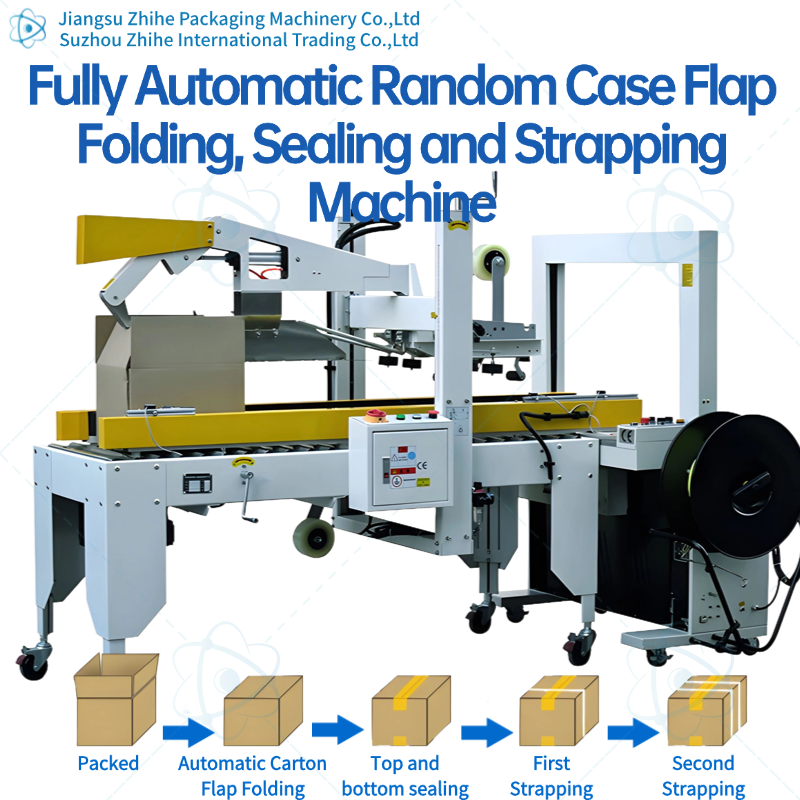
This machine is an integrated unit designed to fully automate the final external packaging process for regular slotted container (RSC) cartons. It streamlines the three key steps into one continuous operation:
What is the standard workflow and core function of this automatic flap folding, sealing, and taping machine?
A:
This machine is an integrated unit designed to fully automate the final external packaging process for regular slotted container (RSC) cartons. It streamlines the three key steps into one continuous operation:
Carton Forming & Infeed: The machine automatically erects a flat RSC carton blank. The product or inner packs are then manually or automatically loaded into the open carton.
Flap Folding & Sealing: The machine conveys the loaded carton through a series of precise guide rails and mechanical arms. These mechanisms first fold the minor (inner) flaps and then the major (outer) flaps on both the top and bottom of the carton in the correct sequence.
Taping Application: Immediately after the flaps are folded, the carton passes under taping heads. These heads apply pressure-sensitive adhesive tape (typically OPP or PVC) across the center seam and both ends of both the top and bottom flaps, creating a secure, tamper-evident seal. The finished, sealed carton is then discharged onto a conveyor for palletizing.
Q:
What is the typical operating speed, and what factors determine the maximum throughput?
A:
Standard machines operate at speeds ranging from 8 to 25 cartons per minute (CPM). The exact throughput depends on several factors:
What is the typical operating speed, and what factors determine the maximum throughput?
A:
Standard machines operate at speeds ranging from 8 to 25 cartons per minute (CPM). The exact throughput depends on several factors:
Carton Size: Smaller, more standardized cartons can be processed at higher speeds. Larger or irregular cartons require slower, more careful handling.
Tape Configuration: Applying tape to both top and bottom (“four-corner” or “six-corner” seal) takes slightly longer than taping only the top.
Infeed Synchronization: The ultimate speed is often limited by the consistency and pace of the upstream process (manual or automatic loading). The machine can be adjusted to match the line's overall takt time.
Q:
How adaptable is the machine to different carton sizes? What is involved in a changeover?
A:
The machine is highly adjustable for a defined range. Key adjustable components include:
How adaptable is the machine to different carton sizes? What is involved in a changeover?
A:
The machine is highly adjustable for a defined range. Key adjustable components include:
Conveyor Guides & Side Belts: Manually or motor-adjustable to accommodate different carton widths.
Flap Folding Mechanism: The height and position of folding arms and guide plates are adjustable to suit carton height and flap length.
Taping Heads: The taping heads' vertical and horizontal positions can be fine-tuned to ensure perfect tape placement on different-sized cartons.
Changeover Process: A full size changeover typically involves adjusting these mechanical points according to pre-set scales or an HMI-driven motorized adjustment system. For frequent changes between a few standard sizes, it can often be completed in under 5 minutes with quick-release mechanisms. All parameters can be saved in recipes on the touchscreen HMI.
Q:
What types of cartons and tape can it handle? Are there any material limitations?
A:
Carton Compatibility: It is designed for standard corrugated RSC-style cartons. Cartons with excessive warping, damaged flaps, or very low-quality/flimsy corrugation may cause jams or imperfect sealing. The machine can typically handle carton lengths from 150mm to 600mm, widths from 100mm to 500mm, and heights from 80mm to 500mm.
What types of cartons and tape can it handle? Are there any material limitations?
A:
Carton Compatibility: It is designed for standard corrugated RSC-style cartons. Cartons with excessive warping, damaged flaps, or very low-quality/flimsy corrugation may cause jams or imperfect sealing. The machine can typically handle carton lengths from 150mm to 600mm, widths from 100mm to 500mm, and heights from 80mm to 500mm.
Tape Compatibility: It is compatible with standard pressure-sensitive adhesive tapes, most commonly:
OPP (BOPP) Tape: The most common, cost-effective option for general sealing.
PVC Filament Tape: Offers higher tensile strength for heavier cartons.
Acrylic or Hot-Melt Tape: For specific adhesion requirements.
The machine can accommodate various tape widths (e.g., 48mm, 60mm, 72mm) by changing the taping head cartridge or rollers.
The machine can accommodate various tape widths (e.g., 48mm, 60mm, 72mm) by changing the taping head cartridge or rollers.
Q:
What are the key safety, maintenance, and durability features?
A:
Safety Features: The machine is fully enclosed with interlocked safety guarding. Opening any guard during operation triggers an immediate emergency stop. It features overload protection on drive systems and clearly marked emergency stop buttons.
What are the key safety, maintenance, and durability features?
A:
Safety Features: The machine is fully enclosed with interlocked safety guarding. Opening any guard during operation triggers an immediate emergency stop. It features overload protection on drive systems and clearly marked emergency stop buttons.
Routine Maintenance:
Daily: Clean tape residue from rollers and cutters; inspect and clear any debris from guides and sensors.
Weekly: Check and adjust belt tension; lubricate guide rails and chain drives as specified.
Monthly: Inspect wear parts like taping head blades, drive belts, and friction pads; verify the alignment of all mechanical components.
Durability Design: Constructed from heavy-duty steel and aluminum profiles with powder-coated finishes. Critical motion components use industrial-grade bearings and guides. The control system employs robust PLCs and industrial-grade sensors to ensure long-term reliability in demanding environments.